

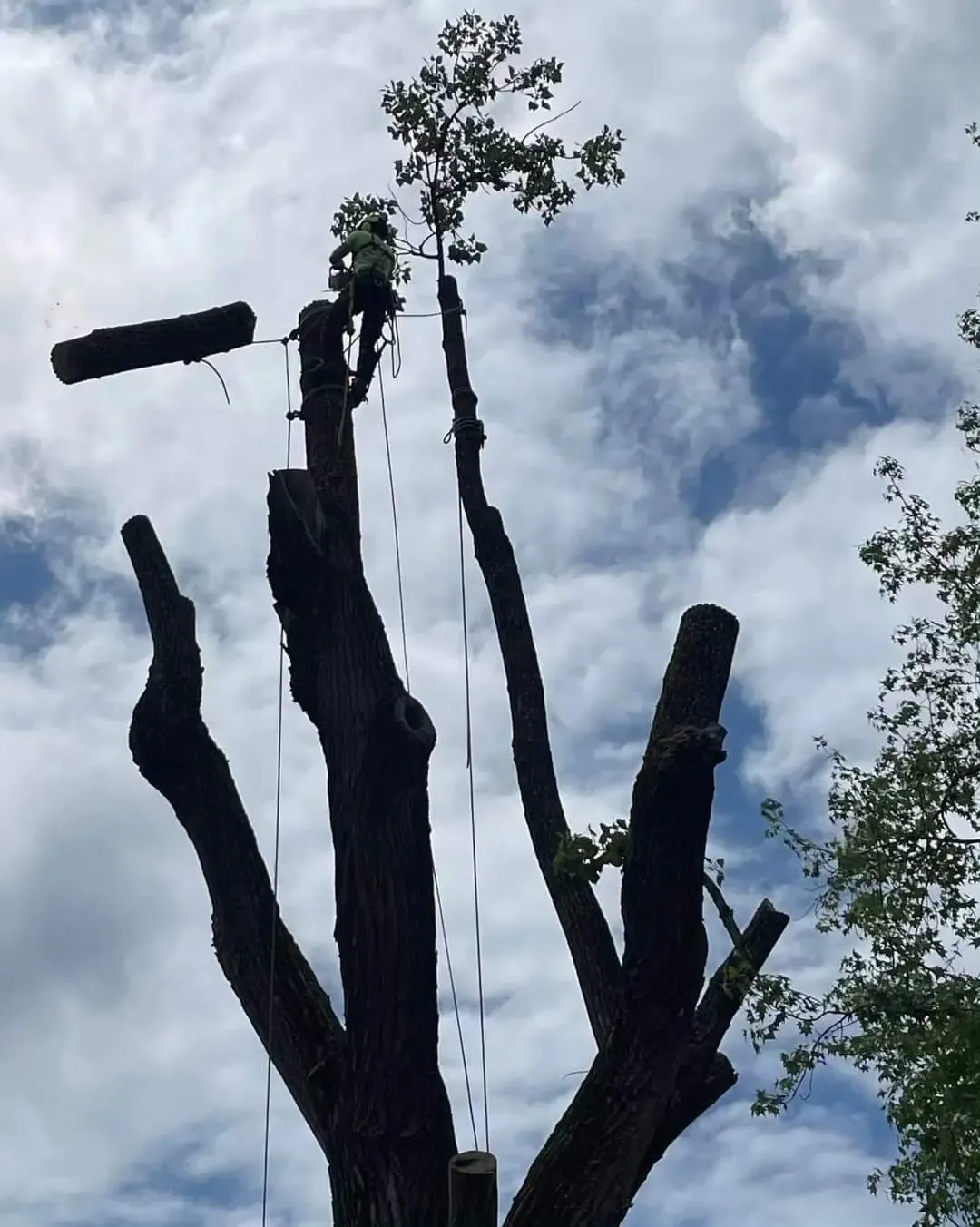
Before you sign, get three things in writing: proof of insurance sent to you by the company's insurance agent, an estimate that says what happens to every tree, stump and pile of brush, and the payment terms.
Are You Insured, and Will Your Agent Send Me the Certificate?
Tree removal is heavy, dangerous work, often right beside the house. If a limb lands on the roof, or a worker is hurt in your yard, someone's insurance has to pay. Two policies matter:
- General liability, which pays for damage to your property or a neighbor's.
- Workers' compensation, which pays for injuries to the crew.
Ask for a certificate of insurance, and ask that it be sent to you directly by the insurance agent. NC State Extension's guide to hiring tree care recommends that, and says to call the insurance company to confirm the policy is current, even when the certificate has not expired. The Missouri Department of Conservation's storm brochure also says to call the insurer to confirm the policies are in effect. A photocopy can be out of date.
When the certificate arrives, check that the business name matches the estimate, that the dates cover the day of the job, and that both policies are listed.
Under Missouri law (RSMo 287.030), most employers must carry workers' compensation once they have five or more employees, and construction employers once they have one. The statute does not say whether a small tree crew counts as construction, so ask each company directly whether its crew is covered. The Tree Care Industry Association warns that if the company you hire has no insurance, you could be held responsible. You can look up whether a Missouri employer has a workers' compensation policy on the Missouri Department of Labor's "Are You Covered" page. The department calls the lookup a guide and recommends calling the listed carrier to confirm.
Does a Tree Service Need a License in Missouri?
Missouri has no statewide license for tree services or arborists. A 2002 Missouri Department of Conservation article noted that the state has no regulatory group responsible for tree care standards.
Two other rules may apply. A company that sprays or injects trees for pay needs a Missouri pesticide applicator license from the Department of Agriculture. And the City of Branson requires contractors to register with the city before they work inside city limits. If the job is in town, ask whether the company holds a Branson contractor license.
Is Anyone on the Crew an ISA Certified Arborist?
The International Society of Arboriculture runs the Certified Arborist credential. To sit for the exam, a person needs at least three years of full-time experience in arboriculture, or a mix of education and experience. The exam is 200 multiple-choice questions. The certification lasts three years, and keeping it takes 30 continuing education units in that time. It is voluntary.
To confirm a certification, ask for the certification number and check it in ISA's credential directory, which treesaregood.org links to. The "Find an Arborist" listing on the same site is voluntary, so a missing name does not mean the person is uncertified.
The Tree Care Industry Association also accredits whole companies. It is voluntary as well, and it involves an in-person audit of the company's training, safety and business practices.
Certification counts most when the tree is one you want to keep: how to prune it, whether a crack or a cavity makes it unsafe, whether it can be saved. For a dead tree that is coming down, ask how it will be rigged and whether anyone will climb it, since dead wood can be unsafe to climb.
What Should the Written Estimate Say?
A spoken price for "taking down the big oak" leaves too much to argue about later. The estimate should describe each tree well enough that nobody can mix it up with another one ("the white oak by the driveway"), and it should answer these questions:
- The stump. Is grinding included? Extension guides from South Dakota State and Iowa State describe grinding a stump 8 to 12 inches below the ground, along with the big surface roots. On rocky Ozarks ground, ask what happens if the grinder hits rock before that depth.
- The grindings. Those same guides note that the price usually does not include hauling away the chips or filling the hole with soil. Ask which you are getting.
- The wood. Hauled away, or cut to firewood length and stacked? Where?
- The brush. Chipped and hauled, or chipped and left for mulch?
- Access. What equipment comes into the yard, along what path, and who fixes ruts in the lawn or a cracked driveway?
- Underground lines. Missouri 811 asks homeowners to make sure their contractor has called before any digging starts. A stump grinder cuts below the ground, so ask who makes the call. It is made at least three working days ahead, and the utilities it notifies mark only their own lines, so mention any private lines you know of, such as a line to a shop or a dock.
- The total. One price for the work described, and anything that could change it.
When two estimates are far apart, compare what each one includes for the stump, the brush and the wood.
How Will You Prune the Trees I'm Keeping?
Topping means cutting a tree's top back to stubs to make it shorter. It is not an acceptable pruning practice under the ANSI A300 pruning standard. The ISA's homeowner brochure on topping adds that because topping is considered unacceptable, damage from a topped tree's branches failing could result in a finding of negligence.
Ask whether the climber will wear spikes. Spikes wound the bark and can reach the living tissue under it. The A300 standard says climbing spurs are not to be used for pruning, apart from a few exceptions, such as an emergency or bark thick enough to protect the living tissue. The Missouri Department of Conservation's storm brochure says a conscientious arborist will not use climbing spikes unless the tree is coming down or someone is hurt. Spikes on a tree that is being removed are normal.
If the tree is an oak, ask when the work will be done. The Missouri Department of Conservation advises against pruning or wounding oaks from mid-March through June, when insects can carry oak wilt into fresh cuts.
How Does Payment Work?
The Missouri Attorney General's advice after storms is to not prepay for work, never pay in cash, and get everything in writing. Paying when the job is done, with a written receipt, means you still hold the money if something is left unfinished. If a company still asks for a deposit, get in writing what it covers and when the balance is due.
Under the Federal Trade Commission's Cooling-Off Rule, a contract of $25 or more that you sign at your home generally gives you until midnight of the third business day to cancel, and the seller has to give you a cancellation form. That holds even when you invited the company out. The exception most likely to apply to tree work is an emergency you called them about, where you write, date and sign a statement in your own hand that describes the emergency and gives up the right to cancel.
What Changes After a Storm?
If a tree is touching a power line, stay clear of it and call the electric utility first. Before any storm work starts, call your homeowner's insurer. The Missouri Department of Conservation's storm brochure says many policies cover at least part of a removal when the house is damaged. A tree lying in the yard, not hung up in another tree, can wait a day for a certificate and a second price.
Door-to-door crews are common after storms, and the Attorney General's office warns about contractors who come to the door and push for a quick decision. Its advice is to get two or three bids and check the paperwork before agreeing to anything. The Missouri Department of Conservation's brochure notes that door knockers are notorious for recommending topping.
What Can You Check Yourself?
- Read the newest Google reviews for the business, the low ones included, and how the owner answered them.
- Look the business up in the Missouri Secretary of State's business search at bsd.sos.mo.gov. A sole proprietor working under their own name may not be listed.
- Check any arborist certification number in ISA's credential directory.
- Look up workers' compensation on the Department of Labor's "Are You Covered" page.
- Read the insurance certificate from the agent, then call the insurer.
When Can You Skip Most of This?
A small job, like grinding one stump in an open yard or cutting up a limb that is already down, does not need two or three bids. It still needs the insurance certificate. The rest of this list can scale to the size of the job and how close the tree is to the house.
If you have a tree you are deciding about, the estimate form is at the bottom of this page. Note what sits under the tree and what you want done with the wood.