

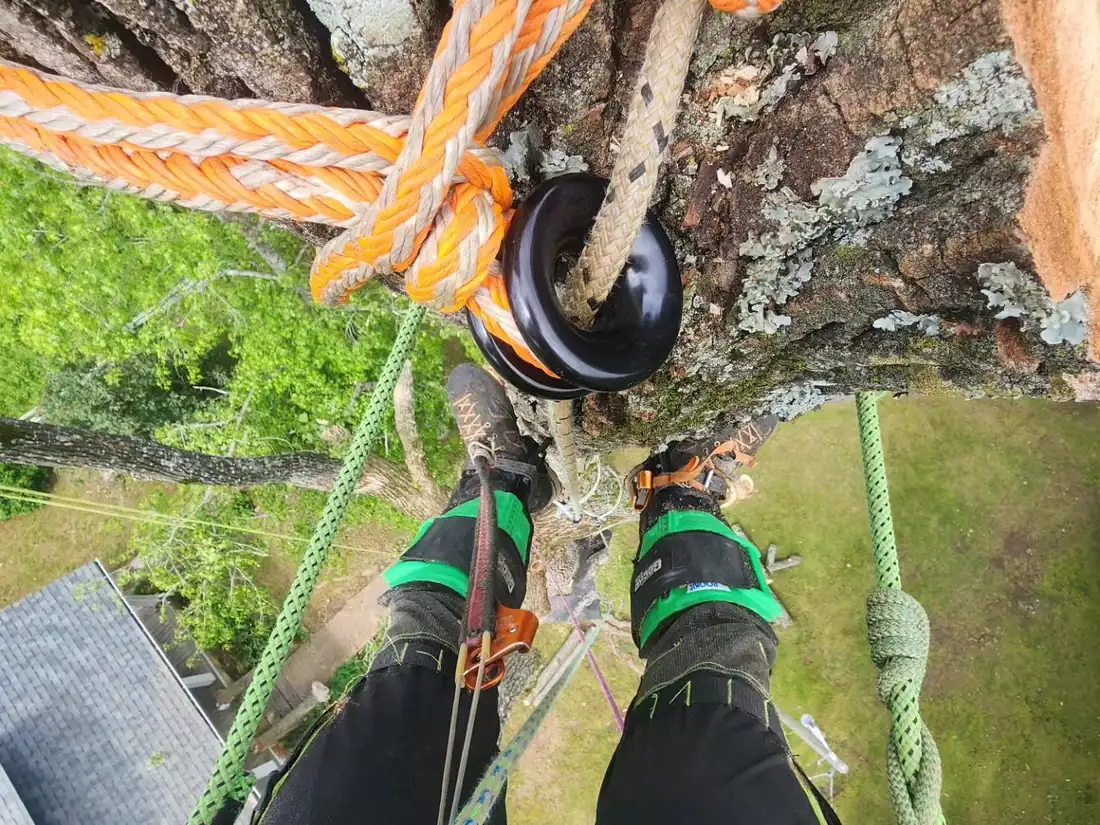
Start with whose land the tree stands on. On Table Rock Lake, the strip between many private lots and the water is federal land managed by the U.S. Army Corps of Engineers, and cutting trees there takes the Corps' written permission, even when the tree is dead or a storm has already knocked it over. On your own side of the line, the slope and what sits below the tree make the work harder than in a flat yard.
Where Does My Property End?
On Table Rock, the government property line is marked with brass survey caps about three and a half inches across, each stamped with a monument number, with a white steel witness post set about a foot away. The Corps' shoreline management page cautions that the witness posts are not legal survey markers and that trees painted with white bands are usually off the line. If you need the exact line, the Corps says the owner has to hire a licensed surveyor at their own expense. The Corps also publishes an interactive shoreline map that shows permit areas around the lake.
Walk the line before anyone cuts. If the tree is on the government side, call the Corps before anyone touches it.
What Does the Corps Allow Below the Line?
The federal rule for Corps lakes (36 CFR 327.14) prohibits cutting trees or parts of trees, or removing wood, from project land without written permission from the District Commander. Clearing on public land is done under a Shoreline Use Permit for vegetation modification, which runs five years and requires the permit holder to mark the government property line.
Table Rock's 2020 Shoreline Management Plan sets the details for those permits. Among them:
- Trees and shrubs up to two inches across at ground level may be removed within a permitted area, and cedars up to three inches.
- Dogwood, redbud and serviceberry may not be removed at any size.
- Trimming, limbing or topping trees is prohibited unless the plan specifically allows it, and limbing for a path is limited to six feet wide and six feet tall.
- Cutting dead trees without a permit is prohibited.
Storm damage does not change the rule. In June 2024 the Corps reminded owners next to Table Rock that they need prior written approval before cutting dead or storm-damaged trees on public property. Inside a permitted vegetation area, a ranger has to approve the removal on site. Outside those areas, damaged trees are not eligible for removal. When a downed tree blocks a permitted path to the shore or a dock, a six-foot section can be cut out to open the path, and the rest of the tree stays on public land. The same notice says burning is not allowed on public lands.
The penalty for breaking these rules (36 CFR 327.25) is a fine of up to $5,000, up to six months in jail, or both.
So a tree on Corps land leaning over your roof starts with a call to the Table Rock Lake Project Office in Branson at (417) 213-4810. Tell them what the tree is over and what shape it is in. A ranger can look at it. The shoreline plan lets the Corps approve removing a standing dead tree, or a dead or live limb, that threatens a permanent structure.
Do Taneycomo and Bull Shoals Follow the Same Rules?
Lake Taneycomo is the reservoir of the Ozark Beach hydroelectric project, licensed by the Federal Energy Regulatory Commission to Empire District Electric, now part of Liberty, and parts of Branson, Hollister, Forsyth and Rockaway Beach sit inside the project boundary. Table Rock's shoreline plan does not govern it. If your lot is on Taneycomo, find out whether the tree sits inside the project boundary before cutting near the water. Liberty, as the license holder, is the place to ask.
Bull Shoals Lake is a Corps lake with its own Shoreline Management Plan, finished in 2018. Changing vegetation on Corps property there requires a permit from the Mountain Home Project Office.
Why Do Lake Lot Trees Cost More to Take Down?
The same oak costs more over a lake house than in a flat yard in town. Four things drive the price:
- The slope. A steep lot changes where a tree can fall and where a truck can park. When there is no room to drop the tree in one piece, it comes down in sections lowered on ropes.
- What is underneath. A roof, a deck, a dock or a boat lift means every piece over it has to be lowered instead of dropped.
- Getting the wood out. If a truck cannot reach the tree, the logs and brush get carried or winched up the hill.
- The road in. Narrow private roads, shared drives and tight switchbacks limit what equipment can reach the house.
Ask any company that bids the job how the pieces will come down and how they will get out.
Who Handles a Tree Near a Power Line?
Lake lots often have lines running down the slope to the house, a shop or the dock, through the trees.
Missouri law (RSMo 319.080 and 319.083) prohibits working where a person or equipment could come within ten feet of a high voltage overhead line, meaning anything over 600 volts, until the utility has been notified and the line is protected or shut off. Federal OSHA rules set the same ten-foot distance for workers who are not trained for line work.
Who handles the tree depends on which line it is. Liberty says it maintains the lines between its poles, and it will inspect a tree within ten feet of one of those lines for free. Keeping trees clear of the service line from the pole to your house is the homeowner's job, and Liberty will disconnect that line at no charge with at least 48 hours' notice so a tree near it can be worked on safely. Parts of Taney and Stone counties are served by White River Valley Electric Cooperative instead, which asks members to notify the cooperative before working within ten feet of its lines. Your bill tells you which one serves your lot.
The Ground Under the Tree
Steep Banks
The Environmental Protection Agency's lake guidance notes that natural shorelines use deep, strong plant roots to hold the soil and absorb wave energy. Clearing every tree off a steep bank above the water takes that hold away. When a tree on a bank has to come down, ask whether the stump can stay in the ground. Its roots keep holding soil while they slowly decay, and North Carolina's cost-share standard for stream debris removal, for one, keeps stumps that are firmly rooted in the soil for that reason. A stump only buys time, though. A slope that is already slipping needs an engineer's look before trees come off it.
Septic Systems
Many lake homes are on septic. The Missouri Department of Health and Senior Services' owner's manual says not to drive or park vehicles on any part of a septic system and to keep heavy equipment off the soil treatment area. It also says existing trees are generally not a problem, although some, like willows, can clog the lines with their roots. Know where the tank and lines are before the crew arrives, and mark them.
Calling 811 Before a Stump Is Ground
Missouri's One Call law defines excavation as any operation that moves or displaces earth with tools or equipment, and a stump grinder does that. Missouri 811 asks homeowners to make sure their contractor has called before work starts, at least three working days ahead. The locate only marks utility lines. The same law leaves lines owned solely by the property owner out of the locate system, and Missouri 811 says those are the landowner's responsibility. It suggests hiring a private locating company for lines to outdoor lights, sheds and other buildings.
When Can a Lake Tree Be Left Alone?
Plenty of big trees on lake lots are healthy and holding the bank. A tree that leans out over the water has often grown that way toward the light and can stay sound for decades. The ones to look at closely have dead tops, mushrooms or soft wood at the base, cracks where big limbs meet the trunk, or a lean that changed after a storm. On private ground, a view can often be opened by removing limbs. On Corps land the shoreline plan prohibits limbing except for a permitted path or, with approval, a limb that threatens a structure.
Brush and small limbs you can reach from the ground on your own lot, well away from any wire, are homeowner work.
If a tree on your side of the line is over the house or the dock, use the estimate form below. Say which lake it is and what sits under the tree.